
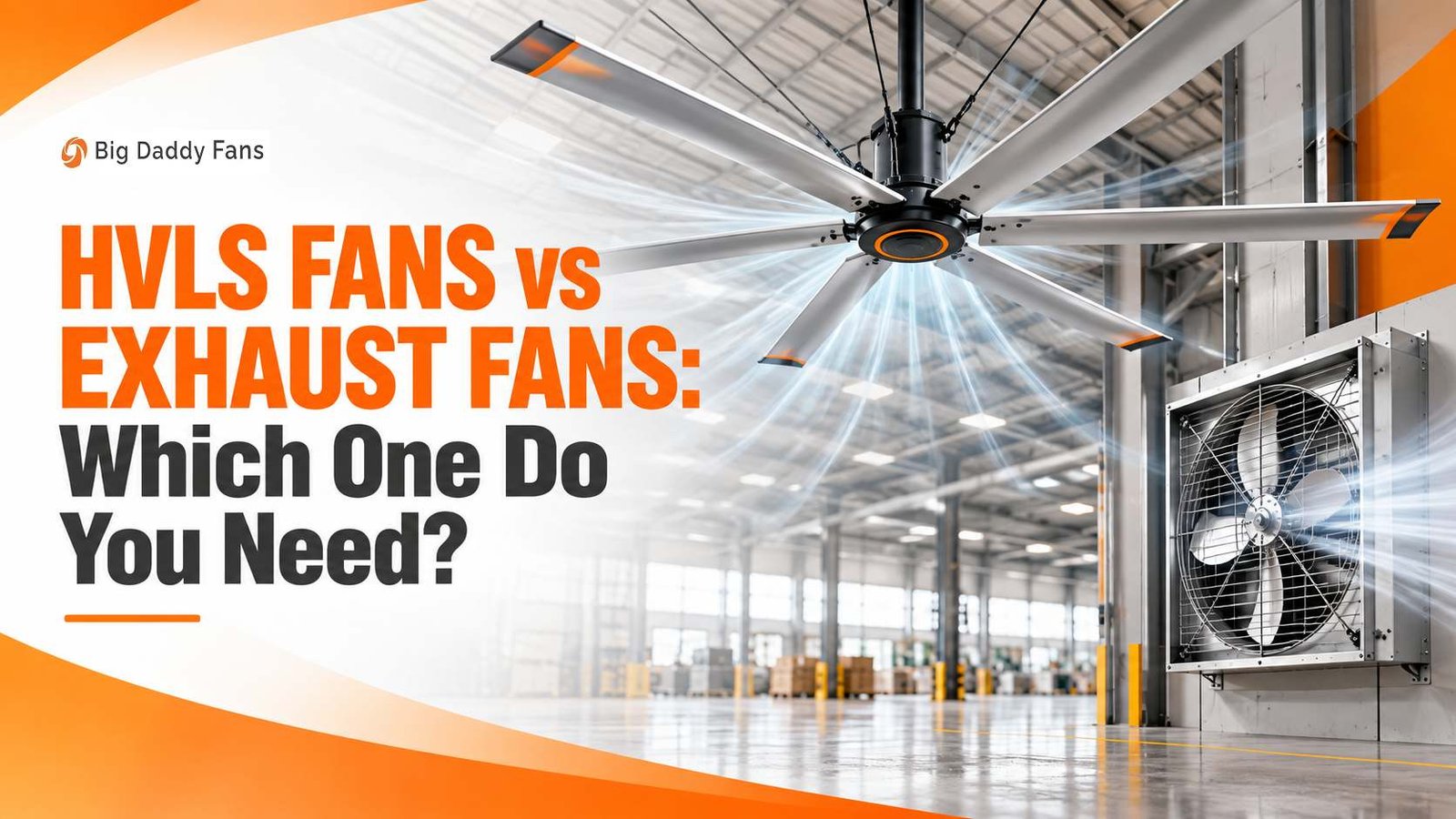
People often look at industrial fans and think HVLS models and exhaust fans do the same job. That is not true.
The main function of an HVLS fan is to circulate and mix air in a large space, while an exhaust fan vents air from inside to outside.
Select the one that fits your needs: air circulation, increased comfort, or extraction of air from the building.
The essence of the split is the airflow. HVLS fans push existing indoor air across wide-open spaces. Exhaust fans open a path that takes unwanted indoor air outside.
|
Factor |
HVLS Fan |
Exhaust Fan |
|
Main purpose |
Air circulation |
Air extraction |
|
Air movement |
Redistributes indoor air |
Removes indoor air |
|
Coverage |
Large, open areas |
Specific ventilation points |
|
Cooling |
Improves perceived comfort |
Removes hot air |
|
Removes fumes/odours |
No |
Yes |
|
Typical installation |
Ceiling |
Wall or roof |
|
Best suited for |
Warehouses, factories, gyms |
Kitchens, factories, workshops |
Use an HVLS fan when you need to distribute air over a large area or floor surface.
Large industrial structures often have areas with poor air circulation, especially near people and machinery. HVLS fans contain wide blades that rotate at a low speed to move lots of air over those open spaces.
If the air is hot and stifling, but there is no need to move contaminated air, the HVLS fan can produce a refreshing breeze over the areas where people are working.
The surrounding region around the roof becomes hot. The circulation of the air will also mix the cooler and warmer layers of air and thereby make the temperature seem more even from floor to ceiling.
If the purpose of the fan is to remove air from inside the building, use an exhaust fan.
Extra heat, dampness, bad smells, and stale air, which accumulate inside, can be drawn out by exhaust fans.
When work produces fumes or other floating contaminants, simply turning the air around with an HVLS fan doesn't solve the air-movement problem. Exhaust systems take the indoor air out and need proper planning around the source plus fresh air coming back in.
Yes. Plenty of large sites get better results by running both rather than relying on just one. An exhaust fan can clear the unwanted indoor air while HVLS fans keep the air moving through the areas people occupy. Plan the two systems as a pair so the circulation does not fight against the path the exhaust needs to follow.
Start with just one question: What is the actual problem you are trying to solve?
Choose an HVLS fan when you need:
Choose an exhaust fan when you need:
Some places need both because circulating air and extracting air do different jobs and are not the same thing.
The right industrial fan starts with knowing what kind of airflow your building actually requires, not just grabbing the fan that shifts the biggest volume of air.
Big Daddy Fans builds HVLS and exhaust fans for industrial and commercial sites, so you can match the equipment to your cooling and ventilation needs.
Whether the goal is steady air movement across a warehouse floor or focused extraction from a production area, we can help you determine the fan setup that fits the space.
09 Dec,2026